The product
Eight modules, one ledger
Switch on what you need. What they share is more important than what each one does: the same customers, the same items, the same accounts — so a figure never needs copying from one screen to another.
What each one covers
Every tile opens a page on what the module does for you and how it works with the rest of the system.
How they fit together
A sale is four things at once
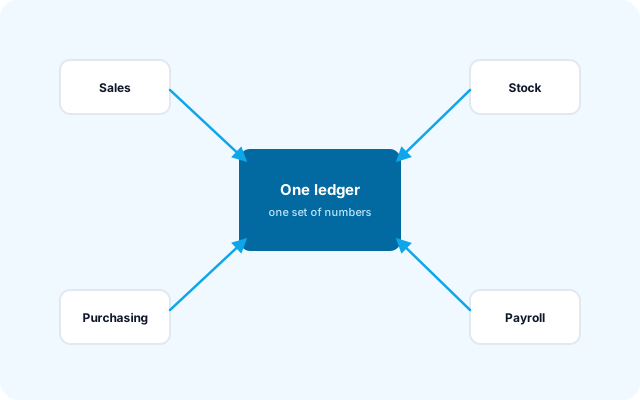
When you raise an invoice, four things happen in the same transaction: the stock moves, the journal posts, the customer balance changes, and the tax document is prepared.
In a system of separate products those are four integrations, each with its own failure mode and its own reconciliation. Here they are one write — which is why the numbers agree rather than needing to be made to agree.
- One customer record, used everywhere
- One item, one cost, one set of units
- One chart of accounts behind all of it
Included in every workspace
Whichever modules you switch on, these come with them:
One ledger behind every module, so sales, stock and payroll post to the same books.
Arabic and English on every screen and in every printed document.
A separate database for your company.
Daily backups.
Exports of every list, at any time, without asking.
Setup help during your trial: we configure the workspace with you.
Questions about the modules
Can we switch on only the modules we need?
Yes, and the ones you do not use stay out of the menu rather than sitting there greyed out. Accounting is always on, because every other module posts to it.
Can we run more than one branch or warehouse?
Yes, from the Professional plan. Each branch has its own cash boxes and linked accounts, stock moves between warehouses with a real journal behind it, and a user can be limited to the branch they work in.
Is the manufacturing module real, or a label on inventory?
Real: bills of materials with yield, routings, production plans that release into work orders, issuance capped at what remains planned, leftover work-in-progress returned on completion, and labour folded into the product cost rather than booked away as overhead.
Is there a point of sale?
Yes — a cashier register with product tiles and a numpad, and a sales history. It posts to the same ledger as everything else, so the till and the accounts cannot disagree.
The register is built for fast cash sales at the counter. A credit sale with payment terms goes through a sales invoice, which posts to the same ledger and appears on the same customer statement.
Are there mobile apps?
Three: a field-sales and CRM app, an employee self-service app for attendance, leave and payslips, and an owner dashboard. They are native apps rather than the website in a frame.
Not sure which you need?
Tell us what your business does and we will tell you which modules matter and which you can leave off.